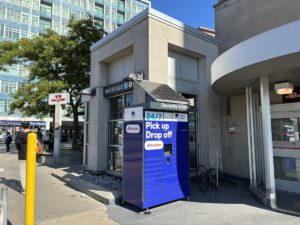
We see that more and more parcel locker network operators face a fundamental question, whether to rely on outsourced locker software solutions or start building your own platform?
In my view, both models have their place and I’d like to share insights from my 15-year career at Omniva to help decision makers understand which is right for their situation.
Fast launch – outsourcing to scale
In 2010, a local startup (Smartpost) was challenging our market position with a new concept of using parcel lockers to distribute last-mile delivery parcels that consumers instantly loved for its convenience and ease of use.
We needed to build a competing parcel locker network fast, so that year began the project to build our network. We outsourced all out-of-home technology, relying on InPost for hardware, “SaaS” software and maintenance. It was the fastest way to launch and scale our network.
As the business grew successfully, we started to realize that owning more control and avoiding vendor lock-in delivers real benefits. Our business case showed that, decoupling hardware from software generated significant CAPEX savings, also being able to develop software functionality ourselves became must-have to continue improving the consumer experience.
So in 2016 we made the decision to start building our own technology stack in-house.
Hidden costs of building in-house parcel locker software
The decision proved successful, but looking back, it required:
And this was just to get the project going, but to keep the system up to date and reliable required ongoing focus and competence building.
Locker technology became its own function within the delivery organization. To share a ballpark on team size, an in-house team requires roughly 12-16 specialists, from product managers to developers, UX/UI, system architects, security & hardware specialists.
In most European markets, the salary costs alone for this setup can run €2 million annually or more.
What areas are often underestimated
In many cases, operators significantly underestimate the full scope of what OOH systems require and understanding that it is not a one-off development project. It’s a long-term commitment:
Integration with legacy systems will always be there, regardless of who builds the locker software. Lockers are one piece of an e-commerce delivery network that requires integration to several systems, whether at the network operator’s side or the customer’s side.
Some operational functions and hardware reliability tweaks only reveal themselves after several years of running networks at scale.
Locker software will never be a classical SaaS product as we think of it
In strategic B2B relationships, partnership and trust are essential.
No one should feel locked in, squeezed or exposed to unmanaged risk or unreasonable fees. The catalyst is often pricing models that tie software fees to the number of lockers, creating linear cost growth that eventually exceeds internal development costs at scale.
How partnerships with domain experts can help
All of this can be reduced and managed by partnering with an experienced team that has already solved these problems, stays fully focused on this domain and constantly learns from multiple projects and markets.
There are several ways to engage an external team or source locker software that properly manage risks for the network operator:
The real question
The choice isn’t simply “build or buy.”
It’s about understanding where your organization should focus its limited time and resources, what risks you can truly manage and what kind of partnership model gives you both control and velocity.
After experiencing both sides of this decision, I believe the answer lies in asking: What business are we in? And what capabilities do we need to own versus partner for?